# A Guide to Nordic and Scandinavian Knitting Traditions
Pick up almost any stranded colorwork sweater today and there's a good chance its ancestry traces back to a fishing village in Norway, a farmhouse in Iceland, or a small cooperative on the Swedish coast. "Scandinavian knitting" gets used as a catch-all term, but it actually covers a handful of distinct regional traditions, each shaped by different histories, different sheep, and different problems knitters were trying to solve. Understanding how they relate—and where they genuinely differ—makes it much easier to recognize what you're looking at the next time you spot a snowflake motif or a yoke sweater in a pattern book.
This guide is meant as a map, not an exhaustive history of any single tradition. We have (or will have) dedicated deep dives on Selbu mittens, the Icelandic lopapeysa, and Fair Isle knitting elsewhere on the site—so think of this as the overview that ties them together.
Why the Nordic Countries Became Knitting Powerhouses
Before you can compare the traditions, it helps to know what they share. Scandinavia and Iceland are cold, historically rural, and largely dependent on sheep farming, which meant wool was abundant and warm knitwear was a genuine survival tool rather than a hobby. Knitting itself arrived in Northern Europe relatively late compared to the Mediterranean and Near East—Norwegian knitted garments have been dated to the 16th century—but once it took hold, it spread quickly through fishing and farming communities, where warm, hard-wearing garments could mean the difference between a productive winter and a miserable one.
Because these regions were geographically isolated from each other by mountains, fjords, and open water, local styles developed somewhat independently, even when they influenced one another through trade routes and the North Atlantic fishing economy. That's the key to understanding this guide: these traditions rhyme with each other, but they are not the same thing.
Norway: Selbu Stars and the Setesdal Lusekofte
Norway is arguably the country most associated with the two-color "snowflake" look that many people picture when they hear "Scandinavian sweater," and it's home to at least two distinct regional traditions worth knowing apart.
Selbu and the Eight-Pointed Star
The Selbu region, in Trøndelag county, is famous for a striking eight-pointed star motif known as the Selburose. According to local history, a young knitter named Marit Emstad is credited with popularizing the design after knitting it into a pair of mittens in 1857; the pattern reportedly caught on so quickly through the surrounding valleys that Selbu alone eventually produced hundreds of registered mitten variations. Selbu work is traditionally worked in just black and white, which makes the graphic punch of the star pattern even more striking against the yarn's natural undyed base.
Setesdal and the Lusekofte
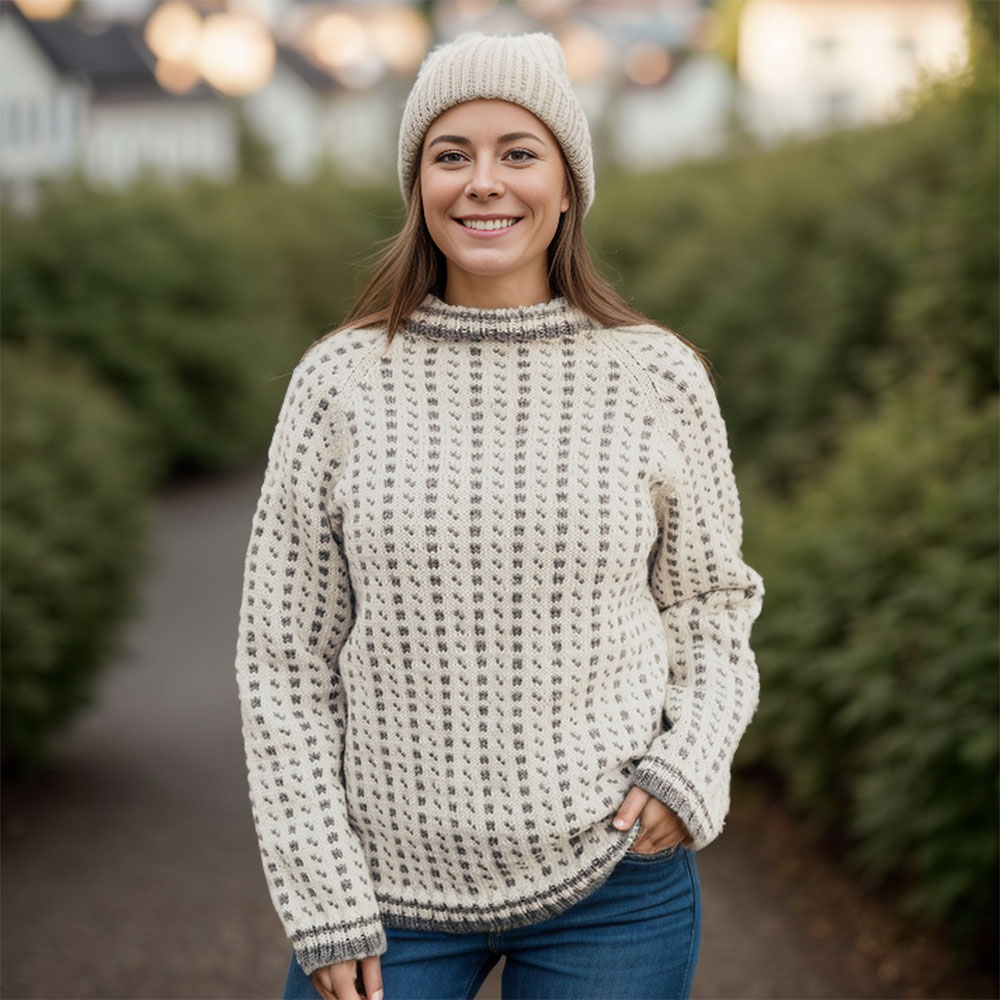
Further south and west, the Setesdal valley gave its name to the lusekofte ("lice jacket"), a black-and-white sweater scattered with small single-stitch "lice" flecks and banded with geometric borders, often finished with embroidered braid trim and pewter clasps at the neck. Where Selbu is best known for a single dominant star motif, Setesdal knitting is more about an overall textured field punctuated by borders—a different visual logic even though the color palette looks similar at a glance.
Together, Selbu and Setesdal illustrate something important about Norwegian knitting: even within one country, "traditional Norwegian sweater" can mean two visually related but structurally different things, and there are further regional variations, like the Fana styles near Bergen, layered on top of those.
Iceland: The Lopapeysa and a Twentieth-Century Invention
Icelandic knitting deserves its own separate deep dive on this site, so we'll keep it brief here—but it's worth understanding how it fits into the bigger Nordic picture, because its story is genuinely different from Norway's.
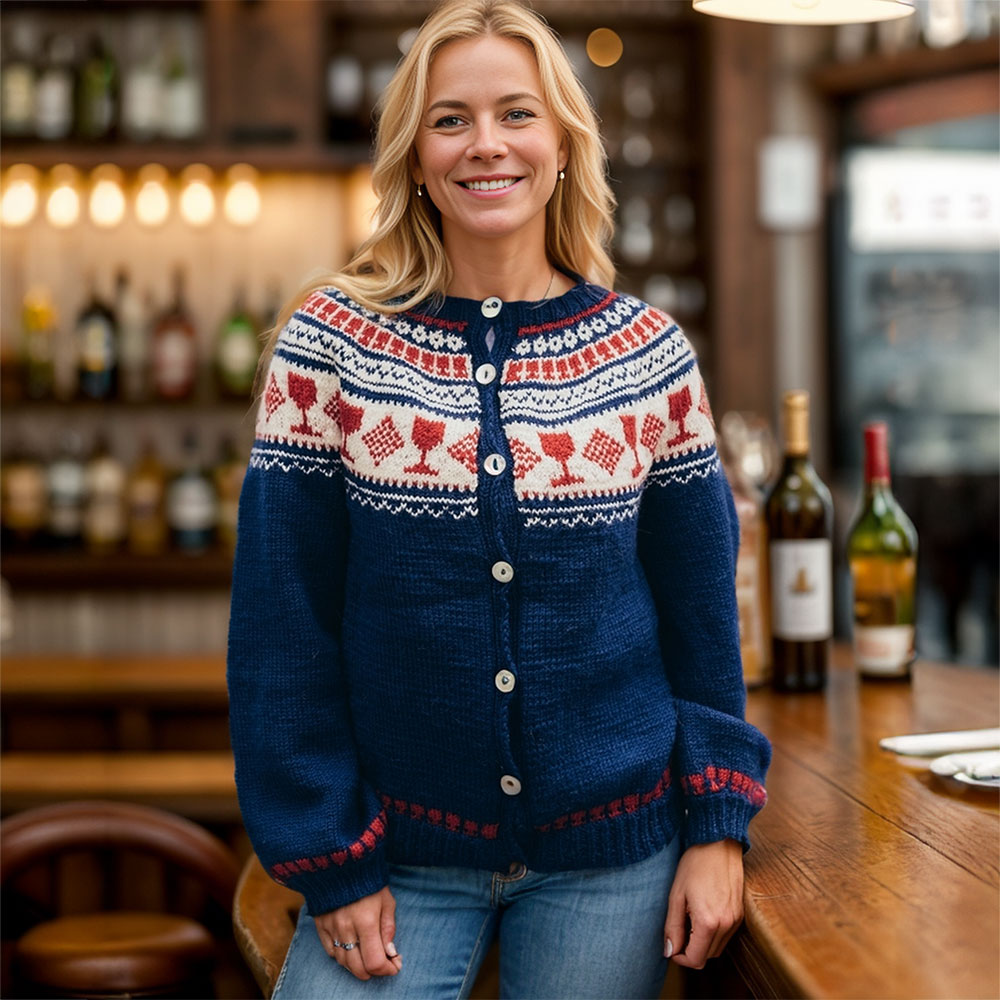
The lopapeysa, Iceland's circular-yoke sweater, feels ancient, but it's a comparatively recent development. Historians generally place its emergence in the early-to-mid twentieth century, arising in part from a Norwegian designer's 1930s "Eskimo" pattern that was itself inspired by Greenlandic dress. The lopapeysa's real innovation is its yarn: lopi, an unspun Icelandic wool that traps more air than conventional spun yarn, making it unusually warm for its weight. The sweater's decorative yoke pattern, worked seamlessly in the round, became closely tied to Icelandic national identity in the years following the country's 1944 independence from Denmark—making it less a centuries-old folk costume and more a modern symbol that drew on older wool traditions to create something new.
That distinction matters when you're comparing traditions: Selbu and Setesdal knitting evolved gradually over generations within existing garment forms, while the lopapeysa was more consciously shaped into a national emblem within living memory.
Sweden: Bohus Stickning's Cooperative Luxury
Sweden's best-known contribution to this story isn't a folk tradition passed down through families so much as a deliberate economic project. Bohus Stickning was founded in 1939 by Emma Jacobsson, whose husband governed the Bohuslän region, as a way to give women reliable income during a period of high unemployment around World War II. What started as simple mittens and socks grew into a full cooperative producing sweaters and jackets in an unmistakable house style: fine-gauge, angora-wool-blend yarn worked in soft, blended color gradations using both knit and purl stitches to create subtle shading effects rather than the bold graphic contrast typical of Norwegian colorwork.
Bohus garments became genuine luxury items, worn by film stars and fashionable clients internationally, before the cooperative closed in 1969. Its combination of fine yarn, muted palettes, and purl-stitch texture makes it easy to tell apart from Selbu, Setesdal, or Fair Isle work even from across a room—it's stranded knitting, but pursuing an entirely different aesthetic.
The Faroe Islands: Shawls Built From the Bottom Up
Sitting between Norway, Iceland, and Scotland, the Faroe Islands developed their own wool tradition suited to a small, sheep-dense archipelago. Faroese shawls are the most distinctive export: rather than being knit top-down like most modern shawls, they're constructed bottom-up from a wide cast-on, shaped through two triangular side panels and a trapezoid back gusset that lets the shawl hug the shoulders without pins. Traditionally worked in garter stitch from the natural browns, greys, blacks, and creams of local sheep, these shawls prioritized fit and function over bright colorwork—a useful reminder that not every Nordic wool tradition is built around stranded patterning.
Shetland's Fair Isle: A Close Cousin, Not a Synonym
Fair Isle knitting isn't Scandinavian at all—it comes from Fair Isle in Scotland's Shetland Islands—but it's so closely associated with this style of knitting that it belongs in any honest overview. True Fair Isle work follows specific rules: only two colors per round, with yarn carried across a limited number of stitches, typically drawing from a broader palette of around five colors across a whole design, often in motifs like "peeries" and OXO shapes. The technique reached global fame after the Prince of Wales wore Fair Isle jumpers publicly in 1921.
Since the 1990s, "Fair Isle" has often been used loosely to describe any stranded colorwork, Scandinavian or otherwise—which is exactly the kind of blurring this guide is trying to untangle. Fair Isle and Norwegian star-motif knitting look related because both rely on stranded, two-color-per-row construction, but they come from separate island and mainland traditions with their own motif vocabularies.
How These Traditions Compare at a Glance
- Norway (Selbu): bold, high-contrast eight-pointed star motifs, traditionally black and white
- Norway (Setesdal): textured "lice" fields with geometric borders and decorative trim
- Iceland (lopapeysa): circular colorwork yoke, unspun lopi wool, a 20th-century national symbol
- Sweden (Bohus): fine-gauge, muted, shaded colorwork using both knit and purl stitches
- Faroe Islands: bottom-up shawl construction in natural, undyed wool tones
- Shetland (Fair Isle): two colors per round, five-ish colors overall, geometric peerie motifs
Why It's Worth Knowing the Difference
None of this is just trivia. Knowing which tradition a technique or motif comes from changes how you knit it: Selbu-style stranding wants high contrast and a steady two-color rhythm, Bohus work rewards patience with fine yarn and subtle shading, and a lopapeysa yoke is really a lesson in circular construction as much as colorwork. The regions borrowed from each other constantly—wool traders, sailors, and pattern books moved constantly around the North Atlantic—so it's more accurate to think of these as related dialects of the same broader language than as sealed-off national styles.
If one of these traditions caught your eye, that's exactly the point of a guide like this: use it as a starting map, then go looking for the dedicated pattern and technique breakdowns for the tradition that pulled you in.