# Garment Ease and Sizing: How to Choose the Right Fit When Knitting
You've found the perfect sweater pattern. You've picked a gorgeous yarn. And now you're staring at a sizing chart with eight columns of numbers, wondering whether you're a Small, a Large, or some frustrating in-between. If that sounds familiar, you're not alone — sizing is one of the most common places knitters get stuck before they've even cast on.
The good news is that once you understand one concept — ease — the whole process gets a lot less mysterious. This guide will walk you through what ease actually means, how to measure your own body and a finished garment, and exactly how to choose a size when your numbers don't line up neatly with the pattern.
What Is Ease in Knitting?
Ease is simply the difference between your body's measurements and the finished measurements of the garment you're knitting. It's the "extra room" (or lack of it) built into a design, and it's the single biggest factor that determines whether a sweater feels snug, relaxed, or roomy — regardless of what size label is attached to it.
Every knitting pattern is designed with a specific amount of ease in mind, and it's usually listed near the sizing chart, often as something like "designed to be worn with 4 inches of positive ease." Understanding that one line can save you from knitting a sweater that technically matches your measurements but doesn't fit the way you pictured it.
There are three categories of ease you'll run into again and again.
Positive Ease
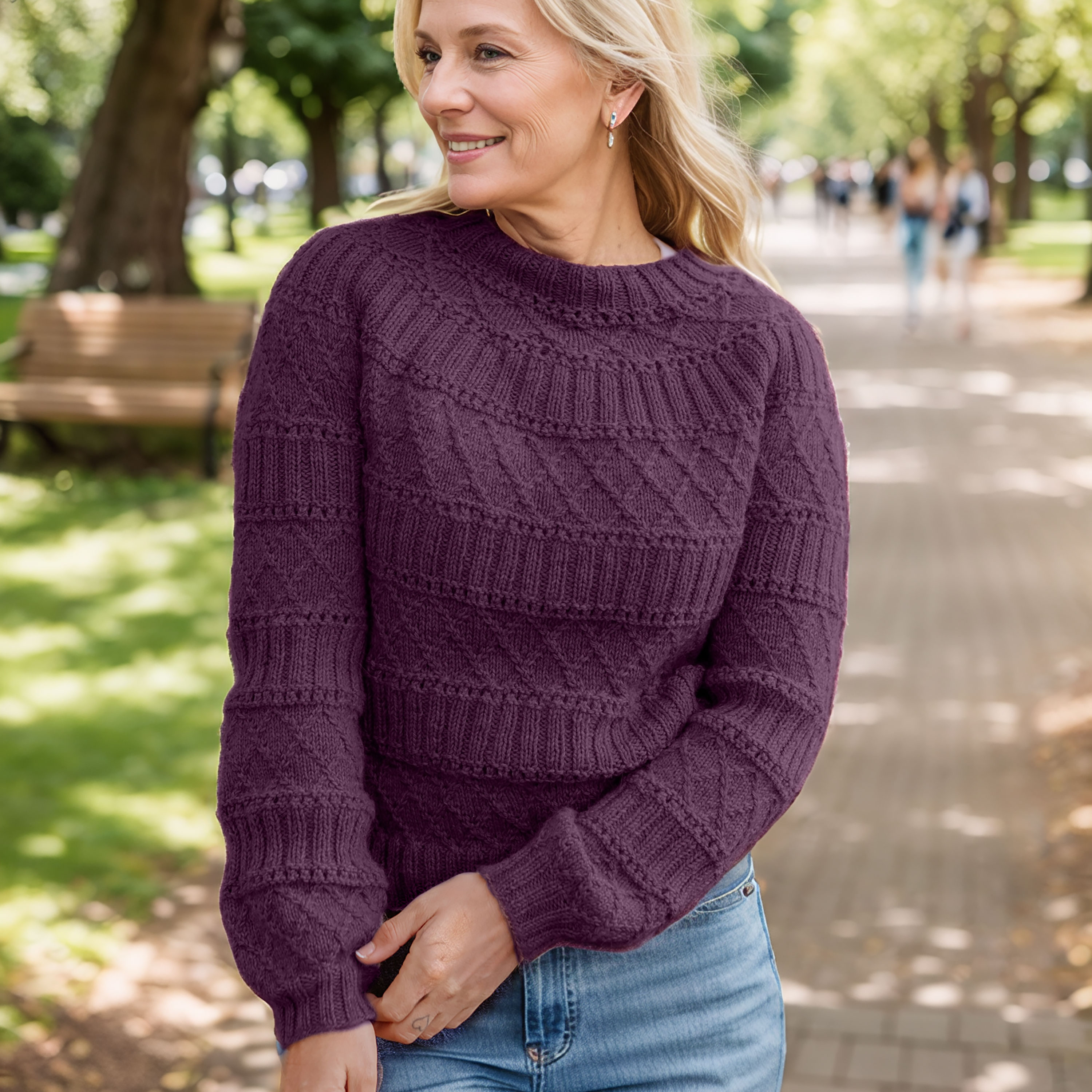
Positive ease means the finished garment is larger than your actual body measurement. A classic, relaxed-fit sweater might have 2 to 4 inches of positive ease at the chest, while an intentionally oversized, slouchy cardigan could have 8, 10, or even more inches of extra room. Positive ease is what gives a garment that easy, roomy drape — think of the difference between a tailored blazer and a cozy oversized cardigan you can layer over anything.
Negative Ease
Negative ease is the opposite: the finished garment is actually smaller than your body measurement, and the knitted fabric stretches to fit. This only works because knitted fabric has natural give, especially in ribbing or stretchy stitch patterns. It's why fitted hats, socks, and close-fitting ribbed sweaters are often knit with negative ease — the fabric needs to hug the body to do its job, whether that job is staying on your head or showing off a shape-hugging silhouette.
Zero Ease
Zero ease sits right in the middle: the finished measurements match your body measurements exactly. This produces a fitted, close-to-the-body silhouette without any stretching or extra fabric. You'll see zero ease used for tailored cardigans, fitted tees, and other pieces where the designer wants the garment to skim the body precisely.
None of these approaches is "correct" — they're simply different design choices, and which one you prefer is largely a matter of personal style. A boxy, oversized pullover and a snug, fitted cardigan might be knit at the exact same gauge from the exact same body measurements, just with completely different ease built in.
How to Measure Your Own Body
Before you can use ease to pick a size, you need accurate body measurements. For most sweaters and cardigans, the chest or bust circumference is the single most important number, since that's the measurement patterns are typically organized around.
- Measure around the fullest part of your chest or bust, keeping the tape measure level and snug but not tight. Wear (or measure over) whatever you'd realistically wear the finished sweater over, since a bulky base layer changes the math.
- If your bust measurement varies a lot from your ribcage measurement, consider also taking a high-bust or upper-chest measurement (around the body, just under the arms and above the fullest part of the bust). Some knitters find this number gives a more useful starting point for sizing, since standard bust measurements can vary widely between people who otherwise wear similar sizes.
- Measure your body length from the base of your neck (or wherever you want the sweater to start) down to where you want the hem to fall.
- Measure your arm length from your shoulder to your wrist, and note your upper arm circumference if the pattern's sleeve sizing is a concern for you.
Write these numbers down. They're your baseline for every pattern you knit from here on, and it's worth updating them occasionally, since bodies (and preferences) change over time.
How to Measure a Garment You Already Love
Numbers on a body don't always translate intuitively into "will this sweater feel right." One of the most reliable shortcuts is to grab a sweater already in your closet that fits exactly the way you want your new one to fit, lay it flat on a table, and measure it directly.
- Chest: Lay the sweater flat and measure straight across from armpit to armpit, then double that number for the full circumference.
- Body length: Measure from the base of the collar (or underarm, to match how patterns usually list it) down to the hem.
- Sleeve length: Measure from the underarm seam to the cuff.
Compare these garment measurements directly to the "finished measurements" column in your pattern's sizing chart, not to your body measurements. This method is often more reliable than working from body measurements alone, because it skips a step — you're comparing garment to garment, and the ease is already baked into the numbers on both sides.
Step-by-Step: Choosing Your Size
Here's how to put it all together when you sit down with a new pattern.
- Find the pattern's finished measurements chart. Every well-written pattern lists the actual finished dimensions of each size — not just a generic Small/Medium/Large label.
- Check the designer's suggested ease. Look for a line noting how much ease the sample was designed with, and picture what that will look like: several inches of positive ease reads as relaxed and layerable, while zero or negative ease reads as fitted.
- Decide on the fit you actually want, which might be different from the designer's suggestion. If you love an oversized look, that's absolutely fine — just be intentional about it.
- Do the math. Take your chest or bust measurement and add (for a looser fit) or subtract (for a closer fit) the amount of ease you want. That target number is what you're looking for in the "finished chest circumference" column, not the raw body-measurement column.
- Find the closest matching size. Scan the finished measurements chart for the size whose chest circumference lands closest to your target number.
- When you're between two sizes, pick based on priority, not panic. It's common for your ideal chest size and your ideal length or shoulder width to point to two different sizes. In that case, choose based on whichever measurement matters most to how the garment will look and feel on you — for most sweaters and cardigans, that's the chest or bust circumference, since it's the hardest dimension to alter after the fact. Length and sleeve length, by contrast, are often easy to customize as you knit.
- Plan simple adjustments for the rest. If you size up for the chest, you may want to knit a shorter body or shorten the sleeves slightly to keep proportions balanced. If you size down, you might add a few extra rows before shaping to restore length.
- Always check your gauge before committing. Sizing charts assume you're knitting to the pattern's stated gauge. Even a small gauge difference compounds across a whole garment, so a quick swatch can save you from a sweater that doesn't match any size in the chart, no matter how carefully you chose one.
A Few Extra Things to Keep in Mind
Fabric and stitch pattern affect how ease behaves. A dense stranded colorwork yoke has very little stretch, so it typically needs a bit of positive ease to go over your head and shoulders comfortably, even if the rest of the sweater is fitted. A heavily ribbed or lace-weight cardigan, on the other hand, might have more give than the numbers alone suggest.
Oversized doesn't mean "size up dramatically" on a fitted pattern. If you want a deliberately loose, drapey silhouette, you'll usually get better results choosing a pattern actually designed for generous positive ease, rather than knitting several sizes larger than your measurements on a pattern drafted for a close fit — proportions like armhole depth and shoulder width don't always scale gracefully that way.
Your preferences are allowed to be your own. Some knitters love snug, second-skin sweaters; others live in giant cocoon cardigans. Once you understand ease, you're free to knit either — on purpose, with a size chosen to get you there, rather than by chance.
With your measurements in hand and a clear sense of the ease you're after, choosing a size stops being guesswork and becomes a simple, repeatable process — one you can use for every sweater and cardigan pattern you pick up from here on.